
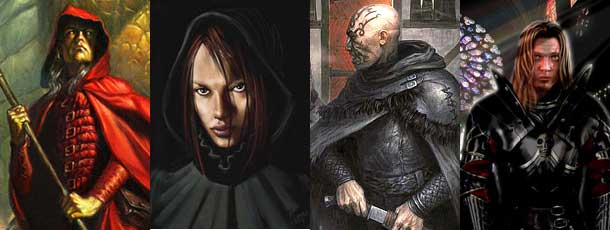


Pergarian humans present a striking and severe physical type, characterized by sharp contrasts and a palpable sense of disciplined intensity. Unlike the warm, earth-bound continuity of the Arelians, the Pergarian phenotype is defined by a cold, monochromatic elegance. They are a population united by a specific, dominant aesthetic that reflects their structured and formidable society, yet varied within it: individuals differ in face, bearing, grooming, ornament, and the marks of age, while each remains unmistakably Pergarian.
Their skin color is consistently pale, decidedly cold, lacking the amber or tan undertones found in other human populations. This pallor is uniform across the body and serves as a high-contrast canvas for their darker features.
Their eye color is intense and deep, centered on a dark, penetrating palette. The most common tones are absolute black or a dark green. More rarely, individuals are born with eyes of a deep amethyst hue—a trait often associated with high-ranking lineages or latent power. Regardless of the specific color, the Pergarian gaze is typically described as piercing and heavy; the eyes do not merely observe, but seem to weigh and analyze. There is a characteristic "calculated stillness" in their expression that suggests a high degree of internal control and a subtle, predatory focus.
Their hair color is remarkably consistent, ranging from night-black to blue-black and violet-black, always within deep, jet-black tones. The hair tends to be thick and possesses a natural luster that reflects light with a blueish sheen. It is rarely prone to natural browning or lightening, even under prolonged exposure to the sun. As they age, Pergarians do not transition through shades of gray; instead, their hair eventually loses its pigment in sharp, snowy white streaks that stand in stark contrast to the remaining black.
Their body shape is characterized by a slim, agile, and wiry build. Pergarians are generally slightly shorter in stature than other humans, possessing a more compact and coiled physical presence. Their posture is habitually inquisitory and dominant, conveying a sense of formal authority and alertness. They are characterized by subtle, intriguing grace.
The overall expression of the Pergarian phenotype is one that is inherently severe and dominant. They often carry an intriguing yet subtle intensity that suggests a cold, evil calculation beneath a mask of formal discipline. Their expression can denote a cunning, secretly mischievous attitude, that hints at hidden motives and a predatory intellect. Taken together, these traits produce a population that feels imposing. This phenotype serves as the visual manifestation of the Pergarian identity: a calculated blend of authority and an unwavering air of superiority.
The Pergarian Aesthetic Canon
Pergarian women strive for a look of
predatory grace. They are
"dangerously beautiful" because they look as though they could charm a person or
ruin them with equal ease. They have long, straight, and jet-black hair that
that shines like obsidian. It may cascade freely, in sinuous waves, down to the
waist, or styled in complex, architectural braids or sleek, severe buns that
pull the skin tight.
Subtle use of deep purple or blue pigments around the eyes is common to make the
gaze appear deeper and more intimidating.
Their body is a slim, willowy figure that suggests agility and controlled grace,
contrasted by full breasts and sculpted, elegant hips and glutes that lend a
quiet sensuality to their silhouette. Their clothing follows the same duality as
their culture. By day it clings closely to the body, tailored with high collars,
sharp shoulders, and calculated openings that reveal measured glimpses of skin,
enough to provoke curiosity and imagination while preserving an aura of
dominance and untouchable allure. By night it may become openly provocative:
deep openings, bare backs and shoulders, high slits, and fine translucent silks
display the body boldly, and in the most decadent nocturnal gatherings the body
may be left almost bare, framed only by silver chains and cold-toned jewels.
Both modes are equally Pergarian and equally controlled, because even in excess
a Pergarian woman decides exactly what is seen.
For men, beauty is synonymous with disciplined power. They do not aim for
"ruggedness" but for a lethal, aristocratic refinement. Facial hair is either
nonexistent or meticulously groomed. There is no room for scruff; every hair
must be in its place, reflecting an obsession with order. A handsome Pergarian
man looks as though he is constantly two steps ahead of everyone else in the
room.
Jewelry: They avoid gold, which they find "gaudy" and "warm." Instead, they
favor silver, platinum,
and cold-toned stones like sapphires, amethysts
Fabrics are heavy and rich—velvets and silks. Their favorite colors are: #151B54
Night Blue, #7E191B Vermilion, #550A35 Purple Lily, #4B0150 Dark Purple, #0C090A
Night, and #0D031B Purple Obsidian
Pergarian Cultural Environment
The Pergarian soul is forged in the biting winds of the stormy seas, where the sun is a distant spectator and the night is the time when they express the truly themselves. They move through the world with a predatory approach, their compact, wiry frames perpetually coiled like a spring-loaded blade. To a Pergarian, dependency is a moral failing; even the lowliest citizen maintains a mask of severe composure, knowing that to beg is to forfeit the right to exist. Their beauty is one of high-contrast elegance—obsidian hair reflecting a blueish luster against skin as pale as sea foam, punctuated by the piercing, heavy gaze of amethyst or jet-black eyes. As they age, they do not wither; they evolve into "Snow-Streaked" icons of cunning, where the raven-black of youth yields to sharp, snowy white streaks—a visual transition from raw physical lethality to a more refined, intellectual dominance.
However, the Pergarian soul is not built upon restraint alone. That is the mistake outsiders make when they encounter them in courts, garrisons, or mercantile halls. Foreigners see only the daylight architecture of Pergarian civilization: the cold posture, the exact diction, the disciplined silence, the predatory scrutiny hidden behind expressions of aristocratic composure. They mistake the mask for the being beneath it.
In truth, Pergarian society is constructed upon a violent division between the public self and the private self, between daylight control and nocturnal release.
The day belongs to order.
Under the pale sun, every Pergarian is expected to embody severity. Emotion is concealed not because they lack passion, but because visible passion is considered vulnerability. To reveal fear, dependency, grief, desire, or uncertainty in public is to surrender leverage over oneself. Their entire social order is therefore inquisitorial in temperament. Every interaction becomes an act of measurement. Every conversation conceals assessment. Even affection is filtered through calculation.
Children are raised to understand that dignity is not a virtue but a weapon. Need must never become visible. To ask openly is shameful. To plead is contemptible. A Pergarian may starve before admitting helplessness, and even among lovers there exists an unspoken expectation that one must remain psychologically armed at all times.
This produces a people of extraordinary internal pressure.
During the day, Pergarians move through society with almost ritual precision. Their cities mirror this mentality: dark stone structures, towering silhouettes, narrow streets designed less for beauty than for psychological dominance. Public spaces are quiet, controlled, and intensely hierarchical. Guards stand motionless for hours. Nobles speak in measured tones sharpened like blades. Merchants negotiate with the emotional coldness of military strategists. Even leisure during daylight carries an undertone of performance and competition.
But this discipline is not equilibrium. It is compression.
Night is what permits Pergarian civilization to survive itself.
When darkness arrives and the streets drown beneath fog, sea-wind, and lanternlight, the cultural mask weakens. The night offers anonymity, concealment, and symbolic liberation from the tyranny of social observation. In darkness, the Pergarian no longer feels fully visible to the judgment of society. Only then can the repressed self emerge.
The transformation is not subtle.
The same people who spent the day as severe magistrates, silent officers, or emotionally impenetrable aristocrats become creatures of dangerous intensity. Pergarian nightlife is infamous even among neighboring civilizations for its extremity. Their feasts are not celebrations of joy but eruptions of psychological release. Luxury becomes excessive because moderation reminds them too much of daytime discipline. Desire becomes ritualized violence against restraint itself.
Their nocturnal gatherings often border upon the ecstatic.
Masked assemblies flood with narcotic smoke and heavy incense. Secretive salons dissolve into philosophical cruelty, seduction, intoxication, and contests of emotional dominance. Pleasure is pursued not delicately, but with the same predatory seriousness they apply to war or politics. Lust, intoxication, pain, ambition, artistic obsession, and even self-destruction become temporary acts of liberation from the rigid architecture of Pergarian identity.
To outsiders, these moments appear chaotic, immoral, even monstrous. But the Pergarians do not see them as degeneration. They see them as necessary release valves. Without these intervals of excess, their society would collapse beneath its own psychological repression.
This duality defines every aspect of their culture.
Their martial traditions reflect it clearly. Pergarian soldiers are terrifying not because they are berserkers, but because they are capable of perfect composure immediately before extreme violence. A Pergarian warrior does not scream in battle. He becomes quieter. The emotional release comes afterward, in blood-soaked revels, private rituals, narcotic stupors, or feverish celebrations hidden from public life.
Their sexuality follows the same pattern. Publicly, Pergarians cultivate an image of aloof elegance and controlled superiority. Privately, desire is intense, theatrical, manipulative, and often inseparable from power itself. Seduction is treated almost as a competitive art form, where psychological conquest matters as much as physical attraction.
Even their aesthetics embody this contradiction.
Pergarian beauty is severe in daylight and intoxicating at night. Their compact, wiry physiques resemble coiled predators perpetually conserving explosive energy. Their obsidian hair reflects a cold bluish sheen beneath moonlight, framing pale skin reminiscent of sea foam under winter skies. Their eyes, often amethyst, black, or silver-gray, carry the unnerving intensity of individuals perpetually analyzing the weaknesses of those around them.
Age does not diminish them. It sharpens them.
Older Pergarians become "Snow-Streaked," a revered transformation in which strands of snowy white fracture through raven-black hair like frost across dark stone. The change is admired because it symbolizes transcendence over mere youthful physicality. A young Pergarian is dangerous through instinct and ambition; an older one becomes feared for intellectual mastery, emotional discipline, and strategic cruelty refined over decades.
To encounter a Snow-Streaked Pergarian is to confront someone who has survived both halves of Pergarian existence: the tyranny of restraint and the abyss of indulgence.
Ultimately, Pergarian civilization is founded upon a paradox. Their society survives through hyper-control, yet their people remain human only through temporary surrender to excess. Daylight creates the mask necessary for power; night permits the release necessary for sanity.
Neither side is considered false.
The cold inquisitor and the ecstatic hedonist are the same being viewed under different light.
For this reasons, Pergarians possess an instinctive affinity for the night and a lingering hostility toward the day. Darkness is not merely environmental to them; it is psychological shelter, the condition under which they feel least imprisoned by the rigid scrutiny of their own culture. The harsh reef-bound coasts from which they emerged, lands of freezing winds, iron-gray seas, and weak sunlight that rarely warms the earth, only deepened this disposition across generations. Their people learned to thrive beneath clouds, fog, moonlight, and storm rather than beneath open skies. This inheritance is written directly upon their bodies: skin of pale whiteness, almost devoid of warmth or gold, standing in striking contrast against obsidian hair and dark, penetrating eyes. Even their beauty reflects the same duality that governs their civilization, the visual opposition between cold light and consuming darkness.
Pergarians possess a deeply conservative attitude toward the integrity of the body. To them, the body is not a canvas for self-expression but an inherited instrument of status, discipline, seduction, and power. Excessive bodily modification is therefore regarded with suspicion, often associated with impulsiveness, emotional instability, social vulgarity, or uncivilized savagery. Large tattoos, scarification, or ornamental mutilation are viewed as practices of uncivilized peoples incapable of understanding restraint. Tattoos do exist within Pergarian society, but they are constrained by strict cultural expectations. Among lower social classes, they frequently serve practical or collective purposes, marking loyalty to mercantile brotherhoods, criminal syndicates, military cohorts, dock clans, or nocturnal fraternities. Among women, tattoos are more tolerated as calculated instruments of seduction, usually placed near intimate or visually provocative areas of the body such as the hips, lower back, inner thigh, or beneath the collarbone. Even then, elegance requires limitation. Pergarian aesthetics reject excess; markings are expected to remain subtle, precise, and deliberately concealed beneath clothing or shadow, transforming revelation itself into part of the sensual performance.
The expression of gender within Pergarian society follows similarly rigid but highly aestheticized principles. Pergarian femininity is cultivated as something intense, controlled, and dangerously magnetic rather than delicate. Women often maintain long hair, treated almost as a symbol of cultivated sensual authority and social refinement. Hair may be ornamented with restrained luxury, and displayed with deliberate theatricality during nocturnal gatherings or aristocratic ceremonies. Long dark hair against pale skin became one of the defining visual ideals of Pergarian beauty. Yet this symbolism changes sharply within martial institutions. Female guards, military officers, and elite soldiers sometimes sever their hair short so they may opt for an open rejection of ornamental femininity in favor of discipline, intimidation, and professional severity. Such women are often perceived with a mixture of admiration and unease, because they embody a partial adoption of traditionally masculine expressions of authority without entirely abandoning Pergarian femininity itself. Although overlaps between masculine and feminine modes of power can occur throughout Pergarian society, they remain culturally uncommon and psychologically charged, precisely because Pergarian civilization places enormous importance upon maintaining visible distinctions between seduction, authority, violence, and social role.

|
PUNTEGGI MINIMI E MASSIMI RAZZIALI PER LE ABILITÀ |
||
| ABILITÀ | MINIMO | MASSIMO |
| Forza | 4 | 18 |
| Intelligenza | 5 | 18 |
| Saggezza | 4 | 18 |
| Costituzione | 3 | 18 |
| Carisma | 3 | 18 |
| Destrezza | 4 | 18 |
|
MODIFICATORI RAZZIALI AI TIRI SALVEZZA |
|
| TIRO SALVEZZA | MODIFICATORE |
| Coraggio | +1% |
| Energia Vitale | -2% |
| Magia | +1% |
| Malattia | -1% |
| Mente | +1% |
| Riflessi | none |
| Robustezza | none |
| Veleno | +1% |
|
ABILITÀ DEI LADRI |
PUNTEGGIO INIZIALE |
| Pick Pocket | 17 % |
| Open Lock | 10 % |
| Find/Rem. Trap | 5 % |
| Move Silently | 12 % |
| Hide in Shadows | 7 % |
| Detect Noise | 15 % |
| Climb Wall | Destrezza + 1/2 Forza (per difetto) + 22% + 21% |
| Read Languages | 0 % |
| FATTORE MOVIMENTO BASE | 8 esagoni |
| SCALARE | Destrezza + 1/2 Forza (per difetto) + 22 % |
| SENTIRE RUMORI | 15 % |
|
DIMENSIONI E PESO |
SISTEMA DI CALCOLO DELL'ALTEZZA E DEL PESO |
| Altezza del maschio | 134 cm. + 3 cm. per punto di costituzione + 2d10 cm. |
| Altezza della femmina | 120 cm. + 3 cm. per punto di costituzione + 2d10 cm. |
| Peso del maschio | 60 kg. + 2 kg. per punto di costituzione + 1d6 kg. |
| Peso della femmina | 50 kg. + 2 kg. per punto di costituzione + 1d6 kg. |
|
CATEGORIA DI ETÀ |
ANNI |
| Starting Age | 15 + 1d4 |
| Childhood | 0 - 15 |
| Adolescence | 16 - 29 |
| Adulthood | 30 - 44 |
| Middle Age* | 45 - 59 |
| Old Age** | 60 - 89 |
| Venerable Age*** | 90 + |
| Maximum Age | 90 + 2d20 |
* Middle Age: I
personaggi di questa categoria di età perdono 1 punto di forza ed 1 punto di
costituzione, acquisiscono però 1 punto di intelligenza ed 1 punto di saggezza
(non potendo, in ogni caso, superare i massimi razziali).
** Old Age: I personaggi di questa categoria di età perdono 2 punti di
destrezza, 2 ulteriori punti di forza ed 1 ulteriore punto di costituzione,
acquisiscono però 1 ulteriore punto di saggezza (non potendo, in ogni caso,
superare i massimi razziali).
*** Venerable Age: I personaggi di questa categoria di età perdono 1
ulteriore punto di destrezza, di forza e di costituzione, acquisiscono però 1
ulteriore punto di intelligenza e di saggezza (non potendo, in ogni caso,
superare i massimi razziali).


Deve osservarsi che per la loro grande versatilità e capacità di adattamento, oltre a disporre dei propri talenti razziali, gli umani hanno accesso ad alcuni talenti razziali delle altre razze. Costoro, infatti, vivendo in gioventù presso i rappresentanti di tali razze possono riuscire ad imparare alcuni dei loro talenti (ad eccezione di quelli che sono legati strettamente a caratteristiche genetiche della razza). Per selezionare tali talenti si consulti il relativo regolamento presente nel link sottostante.

| NOME | Carattere Crudele |
| COSTO IN PUNTI CREAZIONE | 1 |
| REQUISITO PARTICOLARE | ALLINEAMENTO MALVAGIO (EVIL) |
| DESCRIZIONE |
Alcuni Pergariani
hanno un carattere estremamente crudele essendo naturalmente portati per
le azioni malvagie.
Costoro ricevono i
seguenti benefici: |
| NOME | Tradizione nell'uso della Spada Bastarda |
| COSTO IN PUNTI CREAZIONE | 2 |
| REQUISITO PARTICOLARE | NESSUNO |
| DESCRIZIONE |
I Pergariani hanno una
lunghissima tradizione nell'uso della spada bastarda come arma da
combattimento. In particolare, costoro amano la versatilità di tale arma
che può essere utilizzata sia combattendo ad una mano che a due mani
ottenendo il seguente beneficio: |
| NOME | Personalità Dispotica |
| COSTO IN PUNTI CREAZIONE | 2 |
| REQUISITO PARTICOLARE | PUNTEGGIO IN CARISMA ALMENO PARI A 9 |
| DESCRIZIONE |
Alcuni Pergariani
hanno una personalità dispotica essendo naturalmente inclini al comando
ed alla prevaricazione. Costoro ricevono i seguenti benefici: |
| NOME | Carattere Violento |
| COSTO IN PUNTI CREAZIONE | 2 |
| REQUISITO PARTICOLARE | PUNTEGGIO IN FORZA ALMENO PARI A 12 |
| DESCRIZIONE |
Alcuni Pergariani
hanno una personalità particolarmente
violenta e brutale. Per tale motivo costoro ricevono i seguenti
benefici: |
| NOME | Inclinazione ad Uccidere |
| COSTO IN PUNTI CREAZIONE | 3 |
| REQUISITO PARTICOLARE | ALLINEAMENTO MALVAGIO (EVIL) |
|
DESCRIZIONE
|
Alcuni Pergariani sono
contraddistinti da tale malvagità da risultare insensibili alla vita
altrui. Per tale motivo costoro ricevono i seguenti benefici:
|
| NOME | Predisposizione alla Disciplina |
| COSTO IN PUNTI CREAZIONE | 3 |
| REQUISITO PARTICOLARE | ALLINEAMENTO LEGALE (LAWFUL) |
| DESCRIZIONE |
Alcuni Pergariani sono
naturalmente inclini alla disciplina ed all'obbedienza. In particolare
essendo ostinati e rispettosi dei loro compiti sono difficili da
condizionare ed in caso di difficoltà dimostrano maggiore resistenza,
per tale motivo costoro ricevono i seguenti benefici:
|
